Recently, I rewatched San Andreas (2015, Warner Bros. Pictures),
the disaster movie starring Dwayne “The Rock” Johnson and Alexandra Daddario (who more recently appeared in 2023’s Mayfair Witches). And it got me wondering: how much of that enormous “mega-quake” is actually rooted in real science?
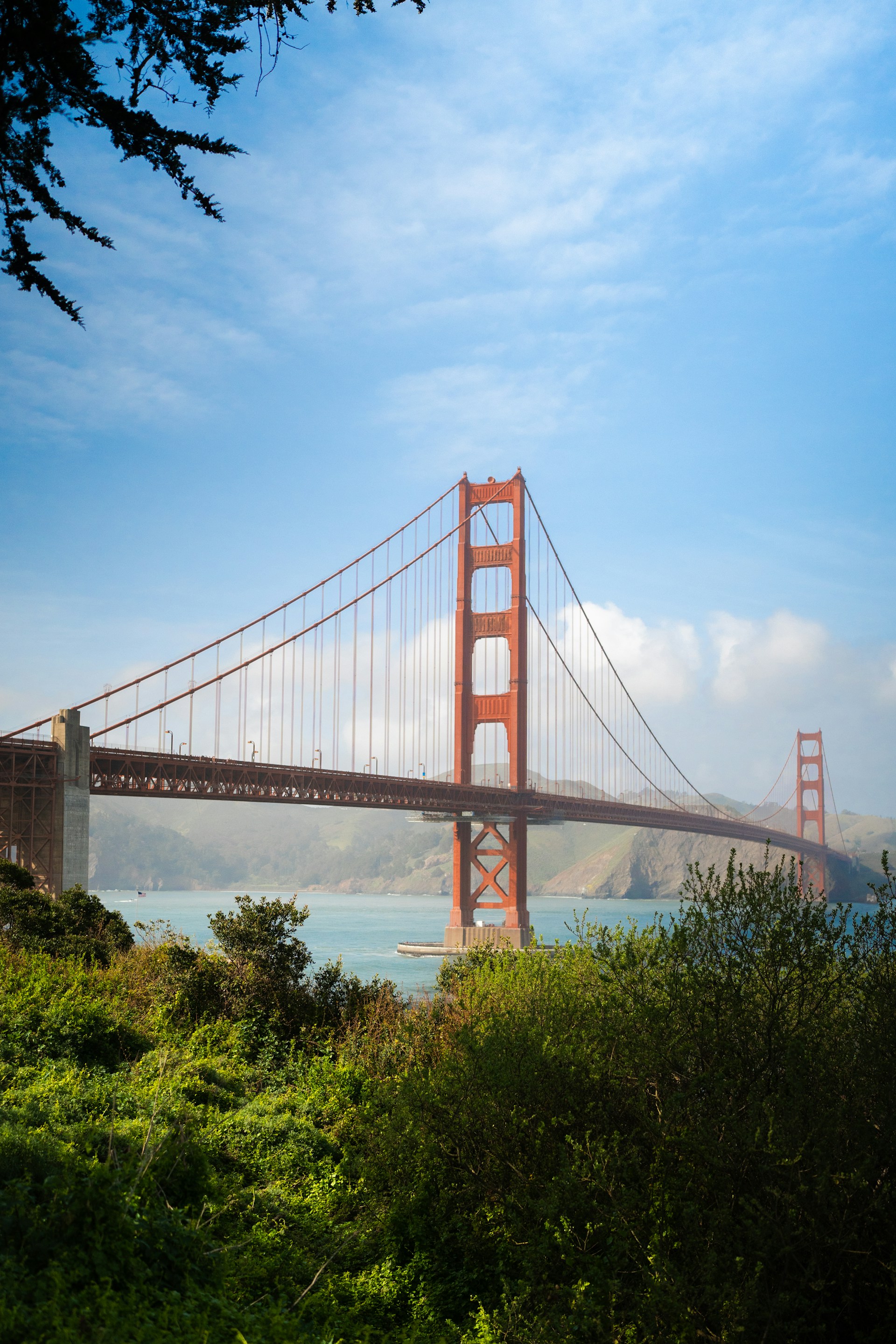
Golden Gate Bridge -
San Francisco, California
Source: Unsplash.com
Sure, movies like this are obviously made for entertainment,
but it’s still fascinating to imagine an event that could happen in some form. In San Andreas, the quake reaches an insane magnitude of 9.6, which is astronomically high. According to the USGS (United States Geological Survey) and multiple seismologists, the San Andreas Fault cannot produce anything that big. Most experts estimate the fault’s upper limit at being around magnitude 8.3.
The real San Andreas fault is long—almost 800 miles—but because it is mostly on land and has what’s called a vertical strike-slip orientation, it wouldn’t actually lift the ocean floor in a way that triggers a massive tsunami like the one seen in the film.
The movie makes for fun over-the-top popcorn entertainment that focuses on a family’s struggle to survive seemingly impossible odds. Ray Gaines (Dwayne Johnson) is an LAFD rescue helicopter pilot, and Blake Gaines (Alexandra Daddario) is his daughter visiting San Francisco, when the first major quake suddenly strikes.
One of the film’s most memorable early moments shows Blake trapped inside the parking garage of a quickly collapsing luxury high-rise. Her SUV is already crushed by falling debris, and the structure of the building begins to fail around her as she tries, in a panicked state, to escape. Scenes like this, while exaggerated, mirror real-world situations where people experience sudden shock, panic, and confusion. For me, it stands out as one of the film’s more effectively crafted segments.
I think the movie’s quiet victory is—despite its huge exaggerations—how it spotlights real issues: disaster response, earthquake preparedness, and the crucial work of seismologists. Paul Giamatti plays Dr. Lawrence Hayes, a researcher trying (and failing) to warn the public in time — which, in a way, feels realistic.
My takeaway? While San Andreas works best as thrilling fiction, it still raises a serious question: Are we truly ready for the next big California earthquake?
It seems worth mentioning that the USGS has pointed out that Hollywood often stretches physics and geology to absurd limits, but that films like this aren’t totally useless as they can spark real conversations and awareness.
I appreciate you taking the time to read this. I’m Sean, the admin behind RAVENSBLOG.NET, and it means a lot to have you here.
Feel free to email me at: ravenxxai16@yahoo.com.
If you want to relive the chaos for yourself, the 4K version of San Andreas is right here — and it looks better than ever: https://amzn.to/4ij4kqO
As an Amazon Associate, I earn a small commission if you purchase through this link — at no extra cost to you.

RAVENSBLOG.NET
a space for travel, tech, insight, and inspiration.
Article #1 Posted on 11/20/25:
San Andreas (2015) Rewatch: How realistic Is the Movie’s Mega-Quake?
Article #2 Posted on 11/22/25:
My M2 MacBook Air Has Been My Daily Driver — But the M4 Sale Is Really Tempting Me
Article #3 Posted on 11/24/25:
Bikini Atoll’s Resilient Reef Sharks: A Quick Look at a Marshall Islands Mystery
Article #4 Posted on 11/28/25:
Top 5 Accessories for Your MacBook Air
Article #5 Posted on 12/7/25:
Brazilian Portuguese for Beginners — Lesson 1
Article #6 Posted on 12/8/25:
Discover the Beauty of Paris: A First-Time Visitor’s Guide to Top Sights and Hotels
Article #7 Posted on 12/9/25:
Brazilian Portuguese for Beginners — Lesson 2
Article #8 Posted on 12/13/25:
Discover the Rhythm of Rio de Janeiro: A First-Time Visitor’s Guide to Top Sights and Hotels
Article #9 Posted on 12/19/25:
Brazilian Portuguese for Beginners — Lesson 3
Article #10 Posted on 12/22/25:
Discover the Heart of London: A First-Time Visitor’s Guide to Top Sights and Hotels
Article #11 Posted on 12/28/25:
Brazilian Portuguese for Beginners — Lesson 4
Article #12 Posted on 1/3/26:
The Best Large OLED TVs to Buy Right Now (2026 Buyer’s Guide) <
Article #13 Posted on 1/5/26:
Brazilian Portuguese for Beginners — Lesson 5
Article #14 Posted on 1/9/26:
Discover the Spirit of Bangkok, Thailand: A First-Time Visitor’s Guide to Top Sights and Hotels
Article #15 Posted on 1/12/26:
Brazilian Portuguese for Beginners — Lesson 6
Article #16 Posted on 1/18/26:
Discover the Charm of Venice, Italy: A First-Time Visitor’s Guide to Top Sights and Hotels
Article #17 Posted on 1/23/26:
Brazilian Portuguese for Beginners - Lesson 7
Article #18 Posted on 1/26/26:
Best Desktop PCs of 2026: Mac mini, Alienware, HP Omen & More